
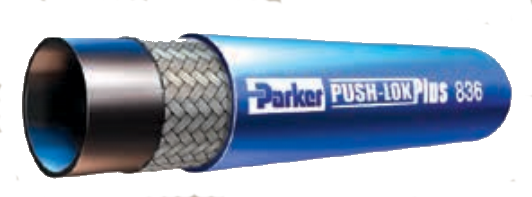
October 27, 2026 — Parker Hannifin’s Hose Products Division (HPD) has announced the planned obsolescence of its 821FR Push-Lok hose due to ongoing supply chain constraints and EHS-related concerns. The company has identified the 836 hose as the approved replacement product, offering equal or superior performance with enhanced safety compliance.
Comparison: 821FR vs. 836 Hose
821FR Hose Applications
According to Parker’s product documentation, the 821FR hose was designed as a versatile multipurpose hose with a fire-retardant (FR) cover, making it particularly suitable for:
- Welding operations and environments where weld spatter is a concern
- General industrial maintenance applications
- Low-pressure hydraulic systems
- Compressed air lines
- Water and coolant circuits
The 821FR featured a synthetic PKR rubber tube with high-tensile fiber braid reinforcement and a special fire-retardant fiber outer cover. It was available in three colors (black, blue, and green) and offered working pressures ranging from 250-350 PSI depending on size, with temperature ratings from -40°C to +100°C (air up to +100°C, water up to +85°C).
836 Hose Applications
The replacement 836 hose is engineered for high-temperature applications and offers several advantages:
- Special high-temperature applications with oil temperatures up to +150°C
- Mining applications — the 836 hose cover carries MSHA (Mine Safety and Health Administration) approval
- Environments where weld spatter may be encountered (testing confirmed suitability)
- High-temperature hydraulic systems
- Industrial machinery operating in extreme conditions
The 836 hose features a synthetic PKR rubber tube with high-tensile fiber braid reinforcement and an MSHA-approved synthetic PKR rubber cover. It offers superior working pressures of 350-400 PSI (depending on size) and an extended temperature range of -48°C to +150°C (air up to +100°C, water up to +85°C).
Key Application Differences
The primary distinction lies in temperature capability and compliance certification. While the 821FR was optimized for fire-resistant applications with moderate temperature requirements, the 836 hose is engineered for demanding high-temperature environments and carries the additional credential of MSHA approval for mining operations.
What MSHA Approval Means in Practice
MSHA refers to the Mine Safety and Health Administration, a U.S. federal agency under the Department of Labor that enforces compliance with mandatory safety and health standards in mining operations. According to MSHA’s official website, the agency’s mission is to prevent death, illness, and injury from mining and promote safe and healthful workplaces for miners.
Practical Implications of MSHA Approval
When a hose cover carries MSHA approval (specifically MSHA IC-40/22 as is the case for the Parker 836 series hose), it means:
- Fire Resistance Testing: The hose has passed rigorous flame resistance testing protocols required for underground mining equipment and operations.
- Material Compliance: The cover materials meet strict standards for use in potentially explosive atmospheres where methane or coal dust may be present.
- Traceability and Documentation: MSHA-approved products require comprehensive documentation and traceability, ensuring quality control throughout the supply chain.
- Legal Compliance: For mining operations, using MSHA-approved hoses isn’t just a best practice — it’s often a legal requirement for certain applications, particularly in underground coal mines and other hazardous mining environments.
- Insurance and Liability: Using MSHA-approved components can be critical for insurance coverage and limiting liability in mining operations.
In practical terms, if you’re operating in mining environments or supplying equipment to mining operations, the 836 hose’s MSHA approval provides an essential compliance advantage that the 821FR did not offer.
The Transition: What You Need to Do
Parker is offering a last-time buy opportunity for the 821FR hose while existing raw materials remain available. Once these materials are depleted, no additional 821FR hose will be produced.
Color Availability
The transition includes the following color changes:
| 821FR Series Hose Color | 836 Series Hose Replacement Color |
| White | Grey |
| Brown | Red |
| Blue | Blue |
| Green | Green |
| Black | Black |
Performance Advantages of the 836
Parker’s engineering evaluation and testing confirmed that the 836 hose meets or exceeds the performance expectations of the 821FR hose, with specific advantages including:
- Higher working pressure ratings (up to 400 PSI vs. 350 PSI)
- Superior temperature performance (up to +150°C vs. +100°C)
- MSHA approval for mining applications
- Confirmed suitability for weld spatter environments
- Enhanced safety and compliance profile
The EHS Concerns
EHS stands for Environment, Health, and Safety — a critical framework that guides manufacturing practices and product sustainability. According to the National Safety Council, EHS programs address workplace safety, environmental protection, and regulatory compliance. In manufacturing contexts, EHS-related concerns typically involve:
- Hazardous material handling and exposure risks
- Environmental impact of raw materials and production processes
- Worker safety during manufacturing operations
- Long-term sustainability of supply chains
While Parker’s announcement doesn’t specify the exact nature of the EHS concerns with the 821FR hose, the company’s commitment to “providing products that meet the highest standards for performance, safety, and long-term availability” suggests the concerns were significant enough to warrant discontinuing the product. The Occupational Safety and Health Administration (OSHA) sets standards that manufacturers must meet, and EHS considerations are increasingly important in industrial product development.
Recommended Actions
If you currently use 821FR hose in your operations:
Evaluate your inventory and determine if a last-time buy is appropriate for your transition timeline
Contact your Western Integrated Technologies Territory Manager to discuss transition planning and 836 hose specifications
Review your applications to determine if the 836 hose’s enhanced capabilities (particularly MSHA approval and high-temperature performance) offer additional benefits
Update specifications and procurement systems to reflect the new product numbers and color rationalization
Plan for assembly — the 836 hose uses the same Series 82 fittings as the 821FR, ensuring compatibility with existing Push-Lok connectors
Parker 836 Series Hose Technical Specifications
- Media: Air (Compressed Air with traces of Oil), Coolants, Fuels (refer to the compatibility chart at the end of Parker Hose Products Catalog 4400 for specifics), Lubricants, Petroleum Hydraulic Fluids
- Compatible Fitting: HY Series, 82 Series
- Inside Diameter: 1/4 inch, 6.3 mm
- Hose Reinforcement Material: 1 Braid of Fiber
- Nominal Hose Inside Diameter: 6 mm
- Outside Diameter: 0.500 inch, 12.7 mm
- Vacuum Pressure Rating: 28 inch-Hg, 711 mm-Hg
- Size: -4
- Maximum Operating Temperature: 212 °F (Air), 100 °C (Air), 185 °F (Water), 85 °C (Water), 302 °F (Oil), 150 °C (Oil)
- Hose I.D. (size): -4
- Design Factor: n/a
- Minimum Operating Temperature: -55 °F (Oil), -48 °C (Oil)
- Maximum Operating Pressure: 400 psi, 2.8 MPa
- Cover Material: PKR® Rubber, MSHA Approved
- Hose Inner Tube Material: PKR® Rubber
- Minimum Bend Radius: 2-1/2 inch, 65 mm
- Weight: 0.09 lb/ft, 0.13 kg/m
- Application: Pneumatics, Petroleum-based Hydraulic Fluids, Lubricating Oils, Diesel Fuels, Antifreeze Solutions
The technical specifications for each size are available on Parker’s website.
